Cattle Versus Hogs: Inside the Protein Spread Three of Our Traders Refuse to Retire
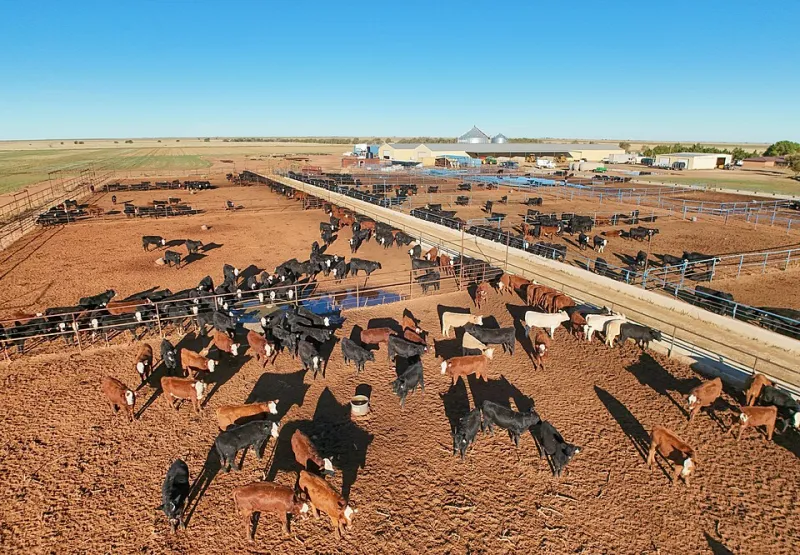
Photo: Quintin Soloviev, CC BY 4.0, via Wikimedia Commons
Every trading floor has its comfort food. For a chunk of our membership, it's the cattle–hog spread — a relationship in the meat complex that has paid the group's bills across more than one cycle and, in 2024, reminded everyone why no relative value trade is a perpetual motion machine.
We pulled three traders into a roundtable to take the spread apart: a sizing hawk, a sizing moderate, and a sizing dove. What follows is edited from that conversation.
Why This Pair Exists at All
Live cattle and lean hogs are both protein, both US commodity contracts, and both sensitive to the same consumer wallet. When beef gets expensive relative to pork at the grocery counter, demand migrates — imperfectly, slowly, but reliably enough that the ratio between the two futures tends to mean-revert around seasonal anchors.
The structural link runs through the feed complex as well. Corn and soybean meal feed both species. A grain rally squeezes hog producers faster than cattle feeders, because cattle carry a longer production cycle that delays their response to input costs. That asymmetry shows up in the spread at predictable points in the calendar.
The Seasonal Map
Trader A (the hawk): "I don't touch this spread blind. The trade has a calendar. Historically, hogs firm into summer grilling demand while cattle supplies follow a slower biological clock. That gives you windows — spring and late fall are where the ratio has tended to stretch, and mean reversion has done the work."
Trader B (the moderate): "Seasonality is the map, not the territory. What makes the trade workable is that both legs are liquid, margined as an intercommodity spread, and correlated enough to the protein complex that you're not taking a pure directional bet. You're betting on a relationship reasserting itself."
Three Traders, Three Position Sizes
The disagreement inside the group has never been about the thesis. It's about the size.
The hawk runs small and adds on adverse movement within hard limits — scaling into a stretched ratio but never averaging beyond a pre-committed schedule. "If the spread is a gift, I want to buy the whole gift, not just the wrapping," he says, though his account statements suggest he buys the wrapping most of the time.
The moderate sizes off volatility. She measures the spread's recent range, stakes a fixed fraction of risk capital per standard deviation, and refuses to adjust mid-trade. "Consistency beats cleverness. My sizing rule is boring on purpose."
The dove — the newest to the trade — sizes smallest of all and treats each entry as a hypothesis test. "I trade a quarter of what I think the position deserves until the thesis proves itself. The market doesn't owe me conviction."
The Entry and Exit Framework
The group's shared framework, roughly:
- Measure the ratio against its trailing seasonal window, not just a raw price spread.
- Enter only in the calendar windows where the ratio has historically stretched beyond one standard deviation.
- Define invalidation in advance — a ratio level and a time stop, whichever comes first.
- Exit on reversion to the seasonal mean, on invalidation, or on the time stop. No discretionary extensions.
The time stop matters more than the price stop, the moderate insists. "Spreads like this don't blow up. They rot. You bleed carry, margin, and attention while the thesis quietly stops mattering."
When It Stopped Working in 2024
Then came last year. The 2024 stretch punished the trade in a way none of the three had mapped: hog supplies tightened on herd liquidation while cattle numbers kept declining from the smallest US cow herd in decades. Both proteins got expensive. The usual demand-substitution logic — the engine of the spread's mean reversion — had nothing to grab onto, because consumers had no cheap alternative to migrate toward.
The ratio didn't stretch and snap back. It drifted, ground higher, and stayed there. The dove's small sizing and time stop saved his quarter. The hawk's scaling plan ran into his own hard limits — which, to his credit, he honored. The moderate lost the least and talks about it the least.
"The lesson isn't that seasonality died," she says. "The lesson is that seasonality assumes a normal supply backdrop. When both legs of your spread are in structural deficit, the historical distribution you're trading off is built on a world that no longer exists."
What the Collective Carries Forward
The trade remains in the group's playbook — smaller, with an added supply-screen checklist before any entry. If both cattle and hog inventories are in pronounced decline, the seasonal map gets suspended until the backdrop normalizes.
Relative value trades earn their keep over years, not quarters. But 2024 taught the group the difference between a spread that mean-reverts and a spread that merely has in the past. The protein pair is still the one they can't quit. It's just no longer the one they trade with their eyes closed.